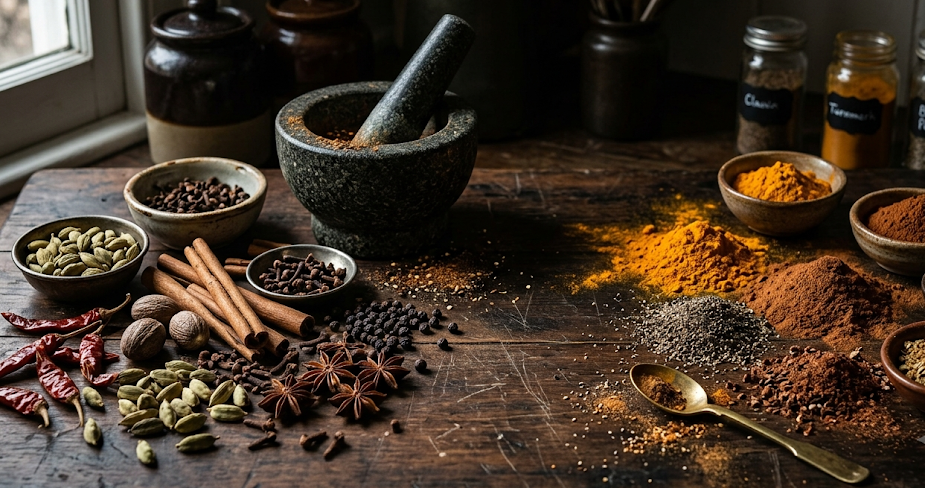
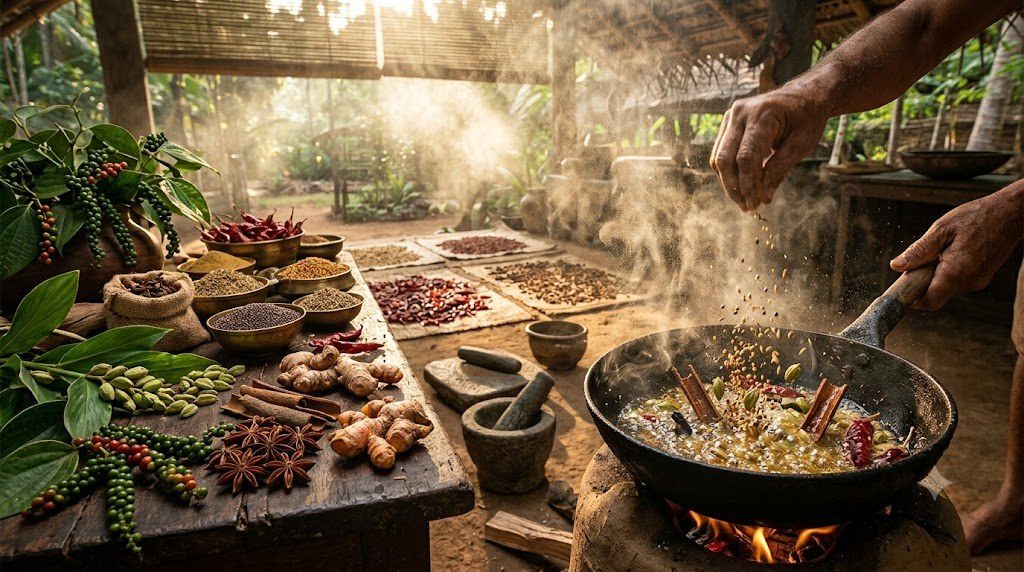
In 1492, Christopher Columbus set sail westward from Palos de la Frontera with royal instructions from the Spanish Crown to establish a direct maritime trade route to the spice-rich kingdoms of India, China, and Cipangu (Japan). Though Columbus never reached the Malabar coast of India or the clove groves of the Moluccas, his trans-Atlantic landfalls in the Caribbean unleashed the Columbian Exchange—the greatest ecological and agricultural convulsion in human history. The collision between the Old and New Worlds permanently reorganized global botany, introducing radical new spice families that colonized the cuisines of Europe, Africa, India, and East Asia within a single generation.
Chief among these New World botanical revolutions were the fiery fruits of the genus Capsicum (Chili Peppers), the climbing orchid pods of Vanilla planifolia, and the all-in-one dried berries of Pimenta dioica (Allspice). Mesoamerican civilizations—notably the Olmec, Maya, and Aztec (Mexica) empires—had cultivated and hybridized these botanicals for millennia before European contact, integrating them into royal religious libations, pharmacopeias, and complex sauces. This comprehensive ethnobotanical and phytochemical treatise examines the domestication of Capsicum species, Maya vanilla agroforestry, the allspice terroir of Jamaica, and the lightning-fast integration of chilies into Indian curries, Sichuan stir-fries, and Hungarian paprikas.
1. The Capsicum Explosion: Five Domesticated Chili Species and Global Conquest
Before 1492, neither India, China, Thailand, Italy, nor Hungary possessed a single chili pepper. The pungency of Old World cooking was derived strictly from black pepper (Piper nigrum), long pepper (Piper retrofractum), ginger (Zingiber officinale), and mustard (Brassica). The introduction of Mesoamerican chilies utterly transformed global culinary architecture due to their unmatched climatic adaptability, ease of cultivation, and explosive capsaicin yield.
Indigenous agriculturalists in the Americas domesticated five distinct species of the genus Capsicum (Nightshade family, Solanaceae):
- Capsicum annuum: Domesticated in Mesoamerica (modern central and southern Mexico). Includes bell peppers, jalapeños, serranos, poblanos (ancho), cayenne, and paprika. The most versatile and widely cultivated chili species worldwide today.
- Capsicum chinense: Despite its misleading scientific name (assigned by botanist Nikolaus von Jacquin who mistakenly believed it originated in China), this species was domesticated in the Amazon basin and Caribbean. Includes habaneros, Scotch bonnets, and modern ultra-hot hybrids (Carolina Reaper, Ghost Pepper). Distinguished by extreme capsaicinoid concentration (100,000 to over 2,000,000 Scoville Heat Units) and prominent fruity ester aromas (ethyl butyrate, hexyl acetate).
- Capsicum baccatum: Domesticated in western South America (coastal Peru and Bolivia). Characterized by yellow or green spots on the corolla lobes of its white flowers. Known as Ají Amarillo and Ají Cristal, prized for crisp, citrusy, berry-like acidity with moderate heat.
- Capsicum frutescens: Domesticated in South America and the Caribbean. Known for erect, upright-pointing fruit clusters and high pungency. The foundational cultivar of Tabasco peppers and African Bird’s Eye (Piri Piri).
- Capsicum pubescens: The high-altitude Andean domesticated chili, known as Rocoto or Manzano. Features distinctive hairy leaves, purple flowers, and jet-black seeds. Tolerates near-freezing mountain temperatures that kill all other Capsicum species.
2. The Portuguese Maritime Vector: How Chilies Reached India and China
How did an indigenous Mexican berry become the defining identity of Indian cuisine within less than a century of its discovery? The answer lies with the Portuguese merchant fleet.
Following the 1494 Treaty of Tordesillas, which divided the non-Christian world between Spain and Portugal, Spanish galleons colonized the Americas while Portuguese armadas commanded the maritime route around Africa to India and Southeast Asia. Portuguese traders carried dried chilies and seeds across the Atlantic to West Africa, around the Cape of Good Hope, and directly into their Indian colonial capital of Goa by 1498–1500.
Indian farmers quickly realized that Capsicum annuum grew with astonishing vigor across diverse soils, matured in four months (unlike black pepper vines which require three to five years to produce fruit), and could be easily sundried and preserved. Within decades, chilies supplanted expensive black pepper as the primary seasoning of the Indian working class, giving birth to fiery Goan vindaloo, Andhra curries, and Tamil sambars.
3. Allspice (Pimenta dioica): The Jamaican Myrtaceous Wonder
Allspice—termed Pimenta dioica (family Myrtaceae)—is the only major Old World-style spice that remains commercially native almost exclusively to the Western Hemisphere. The dried, unripe berries of this aromatic evergreen canopy tree possess a miraculous sensory bouquet that perfectly combines the flavor volatiles of Cinnamon, Cloves, and Nutmeg—inspiring English merchants in 1621 to coin the singular culinary term Allspice.
| Spice Component | Botanical Source | Primary Phenylpropanoid Marker | Synergistic Aroma Characteristics |
|---|---|---|---|
| Clove Top Note | Eugenol (60–80% of essential oil) | 4-Allyl-2-methoxyphenol | Intense, numbing medicinal warmth, sweet woody phenolic bite |
| Cinnamon Under Note | Cineole & Caryophyllene | 1,8-Cineole & Beta-Caryophyllene | Warm, sweet woody spice, rounded balsamic undertone |
| Nutmeg Middle Note | Phellandrene & Terpinolene | Monoterpene hydrocarbons | Rich, warm, savory aromatic complexity, euphoric resonance |
| Peppery Undertone | Resinous Pericarp Tannins | Condensed gallotannins & flavonoids | Slight salivary astringency and palate-drying warmth |
Jamaica enjoys an almost complete geographic monopoly on premium allspice. The limestone karst hills and porous red terra-rossa soils of the Jamaican parishes of St. Ann and Portland provide an ideal terroir. Jamaican allspice berries (Pimento) are prized for containing between 3.5% and 5.0% pure volatile essential oil dominated by eugenol, far surpassing lower-potency Mexican or Honduran varieties (which yield under 2.5% oil and higher myrcene bitterness).
4. Totonac Vanilla and Aztec Xocolatl Libations
While chilies swept across peasant agriculture worldwide, Vanilla planifolia remained an elite, highly secretive luxury. Long before Spanish conquistador Hernán Cortés witnessed Emperor Moctezuma II drinking foamy, bitter chocolate perfumed with vanilla, the indigenous Totonac people of the Mazatlan and Papantla valleys (modern Veracruz, Mexico) were the world’s sole cultivators of the sacred orchid, which they called Xanath (the black flower).
The Aztecs conquered the Totonac territory in the 15th century, demanding tributes of cured vanilla pods (Tlixochitl). In royal Aztec banquets, vanilla was compounded with ground cacao beans, achiote (annatto), wild allspice, chili pepper, and honey, frothed into a thick, ceremonial cold beverage called Xocolatl. When Cortés returned to Spain with cacao beans and vanilla pods in 1528, European royal courts adopted vanilla as an intoxicating aromatic, though Mexico maintained an absolute monopoly on vanilla production for over three hundred years because European botanists could not induce the orchid vines to produce fruit without their native pollinator: the tiny Mexican stingless bee Melipona.
5. Epistemological and Agronomic Impact on Global Agriculture
The integration of Mesoamerican spices caused deep physiological and cultural shifts in global gastronomy. In the Ottoman Empire, Capsicum chilies filtered through North Africa and Egypt, establishing the foundational paprika peppers of the Balkans and Hungary. In Korea, Portuguese merchants introduced chilies via Japan in the late 16th century, leading to a culinary revolution: before chilies, kimchi was preserved with salt, wild mountain herbs, and fermented fish without red pepper. The addition of coarse Korean chili powder (Gochugaru) introduced both capsaicin antimicrobial preservation and lactic acid fermentation enhancement, defining Korean cuisine forever.
Furthermore, in Sichuan, China, the unique geographical pairing of local Zanthoxylum (Sichuan peppercorn) with imported New World chilies synthesized the famous Ma-La flavor profile. Capsaicin provides burning thermal nociception via TRPV1 receptors, while hydroxy-alpha-sanshool in Sichuan peppercorn induces 50 Hz tactile vibration paresthesia, producing a harmonious neurosensory loop unparalleled in world gastronomy.
6. Frequently Asked Questions (FAQ)
Q: Why did Columbus mistakenly call chilies ‘peppers’?
Columbus needed to prove to his royal Spanish sponsors that his expedition had successfully reached the wealthy spice lands of the Indian Ocean. He deliberately mislabeled the pungent American Capsicum fruit as ‘pimienta’ (black pepper) to market it as an Asian spice equivalent.
Q: Did European cuisine immediately adopt chili peppers?
No. With the exception of Spain and southern Italy, much of Western Europe initially viewed chili peppers with suspicion as dangerous ornamental nightshades, using them in gardens rather than kitchens. It was in India, the Ottoman Empire, and Southeast Asia that chilies were enthusiastically embraced as culinary staples.
Q: What are the five domesticated species of Capsicum?
The five species are Capsicum annuum (jalapeño, bell, cayenne), Capsicum chinense (habanero, Scotch bonnet), Capsicum baccatum (ají amarillo), Capsicum frutescens (tabasco, piri-piri), and Capsicum pubescens (rocoto, manzano).
Q: Why is allspice called ‘allspice’ in English?
When English traders encountered the dried unripe berries of Pimenta dioica in Jamaica in the 1600s, they noted that its flavor magically unified the distinct aroma profiles of cloves, cinnamon, and nutmeg in a single spice.
Q: Why couldn’t Europeans grow vanilla beans outside of Mexico until the 1840s?
Vanilla planifolia orchids possess a delicate physical floral flap called the rostellum that prevents self-pollination. In nature, only tiny stingless Melipona bees native to Mexico can navigate this flap. Pods could not be produced abroad until manual hand-pollination was invented in 1841.
Q: How did Hungarian paprika evolve from Mesoamerican chilies?
The Ottoman Turks conquered the Balkans and introduced Capsicum annuum peppers (acquired through Mediterranean trade) to Hungary in the 16th century. Hungarian growers selectively bred the plants in the Szeged and Kalocsa plains for high sugar, ruby color, and reduced heat, creating sweet culinary paprika.
Q: What makes Jamaican allspice superior to Mexican allspice?
Jamaican allspice grows in rich limestone karst soils with ideal tropical rainfall, producing smaller berries containing 3.5% to 5.0% volatile essential oil rich in eugenol, whereas Mexican allspice berries are larger, contain less oil (1.5% to 2.5%), and exhibit higher resinous bitterness.
Q: What was Aztec ‘Xocolatl’ and how was it flavored?
Xocolatl was an unsweetened, frothy ceremonial beverage made from roasted cacao beans whipped with water, cornmeal, vanilla pods (tlixochitl), allspice, chili peppers, and achiote for a sacred reddish tint, consumed by royalty and warriors for stamina.
Q: How did chilies arrive in Sichuan and revolutionize Chinese cuisine?
Chilies entered China via two separate trade routes in the late 16th century: maritime ports in Guangdong and overland trails from Burma into Yunnan. Sichuan chefs discovered that chilies paired brilliantly with native tingling Sichuan peppercorns, creating the iconic ‘Ma-La’ (numbing-hot) culinary foundation.
Q: What is the botanical difference between Black Pepper and Allspice?
Black pepper is the small drupe of a climbing vine in the family Piperaceae, powered by the biting alkaloid piperine. Allspice is the dried berry of a large evergreen tree in the family Myrtaceae, powered by the aromatic phenylpropanoid eugenol.
Q: Can Capsicum pubescens cross-pollinate with standard garden peppers?
No. Capsicum pubescens is genetically isolated from the other four domesticated chili species. It possesses 24 chromosomes with distinct reproductive barriers, preventing viable hybrid seed production with Capsicum annuum or chinense.
Q: Why did the Portuguese distribute chilies so aggressively across Asia?
Portuguese merchant sailors found that dried chilies prevented scurvy during multi-month oceanic voyages due to their high Vitamin C content, while providing an inexpensive, easily transportable trading currency that Asian rulers and local populations eagerly accepted.
Q: What role did Achiote (Annatto) play in pre-Columbian Mesoamerican cooking?
Achiote seeds from Bixa orellana were valued as a sacred crimson colorant representing human blood in Mayan rituals. Beyond coloration, the seeds contain the carotenoid bixin and aromatic terpenes (germacrene, elemene), imparting a subtle peppery, earthy, nutmeg-like flavor essential for traditional Yucatan Recado Rojo and cochinita pibil.
Q: Why does Allspice require whole berries to be ground fresh rather than stored as powder?
Allspice’s essential oil fraction is dominated by eugenol and delicate monoterpenes. When berries are ground into powder, the protective outer pericarp cell walls are pulverized, exposing the volatile oils to atmospheric oxygen. Within 60 to 90 days of ambient storage, over 40% of the volatile aroma compounds evaporate or polymerize, leaving a flat, bitter, dusty powder.