Spice Preservation and Charcuterie: The Antimicrobial Science of Phenolics and Lipid Stabilization
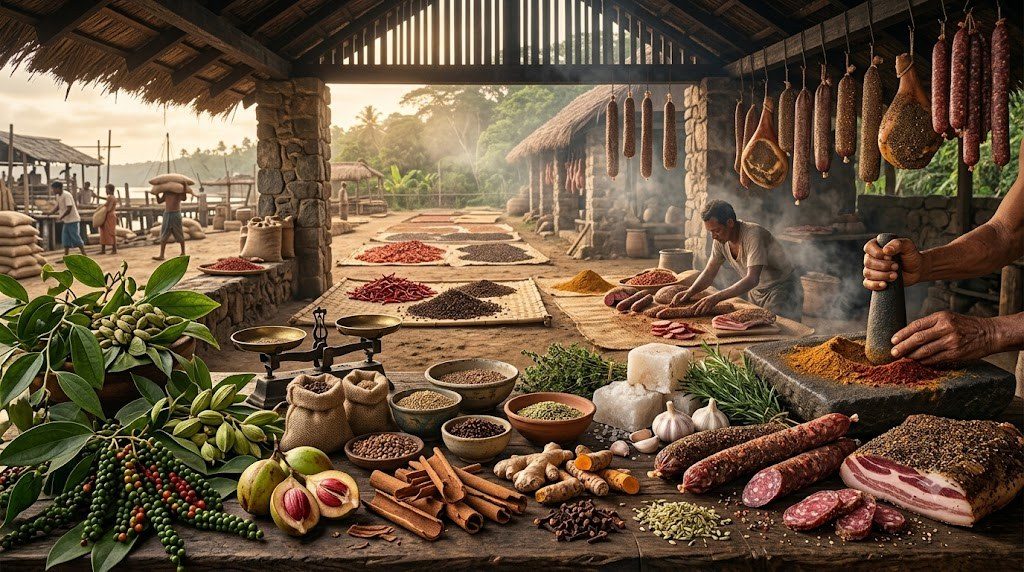
For millennia before the advent of mechanical refrigeration, artificial chemical preservatives, and hermetic vacuum packaging, human civilization relied on an intricate synergy between culinary spices, mineral salts, and fermentation biology to prevent perishable animal proteins from succumbing to deadly putrefaction. From classical Roman salted sausages and medieval Venetian spice-cured hams to Central European charcuterie, Mediterranean … Read more

Sweet Spice Applications: Baking, Confectionery Chemistry, and Retronasal Flavor Synergy

In global culinary science, the classification of certain botanical aromatics as ‘sweet spices’ represents a fascinating psycho-sensory paradox. Strictly speaking, botanicals such as cinnamon, nutmeg, cloves, allspice, vanilla, and green cardamom contain negligible monosaccharides or disaccharides; their caloric carbohydrate content is near zero. Yet across centuries of European, Middle Eastern, and American confectionery and baking … Read more

Whole vs. Ground Spices: Mass Transfer Diffusion, Broth Clarification, and Temporal Flavor Staging

In both the professional culinary arts and industrial food processing, the structural form of an aromatic spice—whether deployed as an intact botanical organ or milled into micro-pulverized particulate powder—dictates every thermodynamic, kinetic, and sensory dimension of the cooking process. The debate between whole versus ground spices is not a matter of aesthetic preference or convenience; … Read more

The Physics of Blooming Spices in Fat: Lipid Solubilization, Tadka Kinetics, and Aerosolization

In the culinary sciences, few operational techniques fundamentally transform food biochemistry as dramatically as the thermal extraction of whole and ground spices into hot culinary fats. Known across the Indian subcontinent as Tadka, Chhonk, Baghar, or Talikka, and widely referred to in Western professional kitchens as blooming or tempering, this process represents far more than … Read more