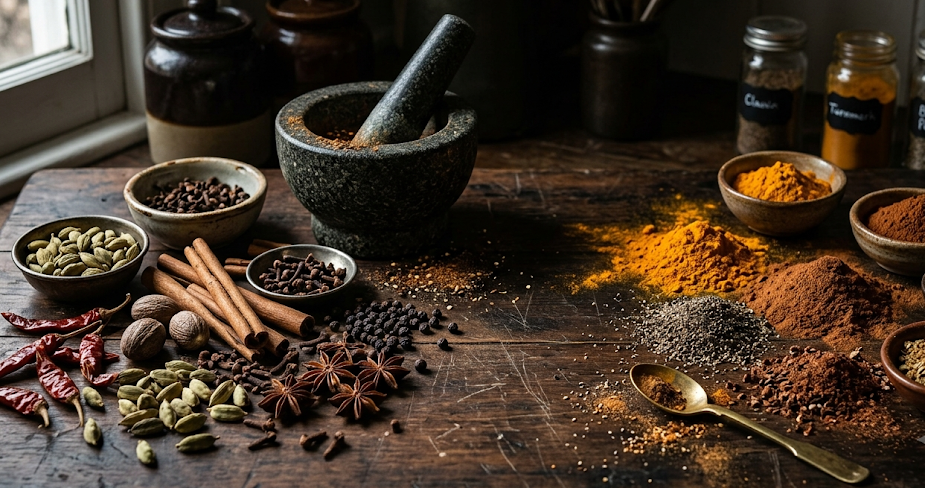
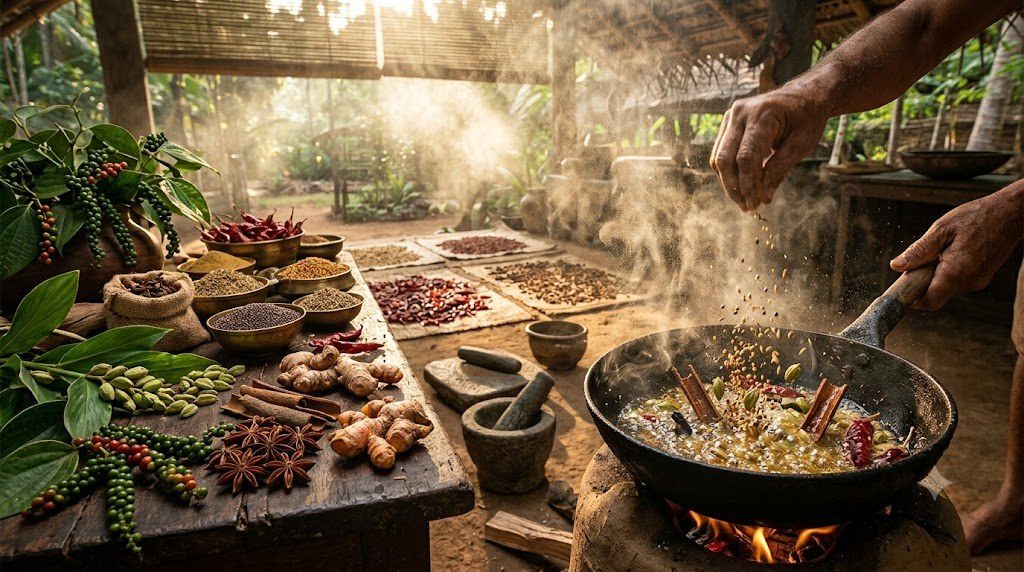
In both the professional culinary arts and industrial food processing, the structural form of an aromatic spice—whether deployed as an intact botanical organ or milled into micro-pulverized particulate powder—dictates every thermodynamic, kinetic, and sensory dimension of the cooking process. The debate between whole versus ground spices is not a matter of aesthetic preference or convenience; it is a fundamental problem of surface area scaling, mass transfer diffusion kinetics, volatilization thermodynamics, and phase extraction dynamics.
When an intact spice seed, bark curl, or flower bud is introduced into a simmering liquid, flavor compounds must migrate through dense, lignified cellular structures via slow liquid-solid diffusion over hours. Conversely, when that same spice is pulverized into a 50-mesh powder, cellular membranes are mechanically annihilated, increasing the surface area exposed to the cooking matrix by several orders of magnitude. Understanding the mathematical and chemical laws that govern this dichotomy allows culinary scientists and chefs to engineer precise flavor release curves across long-simmered braises, delicate sauces, and express tabletop seasonings.
1. Surface Area Mechanics and Cellular Compartmentalization
To grasp the profound behavioral divergence between whole and ground spices, one must examine botanical geometry. Consider an intact black peppercorn (Piper nigrum) with a mean diameter of 4 millimeters, and compare it to that same peppercorn milled into fine powder particles averaging 100 micrometers in diameter:
- Surface Area Amplification: As particle diameter decreases by a factor of 40, the total surface area per unit volume scales inversely by that same ratio. Grinding a single peppercorn increases its active interfacial contact area with surrounding solvents (water, oil, or saliva) by more than 4,000%.
- Elimination of Diffusion Barriers: In an intact botanical drupe, volatile essential oils reside inside specialized glandular trichomes, resin ducts, and specialized secretory cells (vittae in Apiaceae seeds like cumin and coriander). For an essential oil molecule like piperine or cuminaldehyde to escape into a simmering broth, it must dissolve into penetrating liquid and diffuse through tortuous porous channels within the cellulose-lignin cell matrix.
- Instantaneous Surface Solubilization: Pulverization shatters these cellular resin vittae, spilling microscopic pools of essential oils directly onto particle exteriors. When ground powder hits hot liquid, dissolution occurs almost instantaneously at the interface, eliminating internal mass transfer resistance entirely.
2. Extraction Kinetics in Aqueous Solutions: Fick’s Second Law
In liquid culinary applications—such as stocks, consommés, classical French sauces, and Vietnamese pho broths—flavor extraction from whole botanicals is governed by Fick’s Second Law of Diffusion:
∂C / ∂t = D × ∇²C
Where C represents the concentration of the volatile compound in the solvent, t is time, and D is the diffusion coefficient of the solute through the botanical tissue matrix. Because the diffusion coefficient D through dense plant matter is extremely low (10^-9 to 10^-11 m^2/s), the time required for flavor compounds to migrate from the core of an intact whole nutmeg kernel or cinnamon stick into surrounding liquid is proportional to the square of the botanical’s characteristic radius (r^2).
This kinetic reality underpins the culinary logic of Bouquet Garni, Sachet d’Épices, and Vietnamese pho spice bags. In a master broth simmered for 8 to 24 hours, utilizing ground spices would result in catastrophic over-extraction, clouding, and rapid evaporative stripping of delicate top-note volatiles. Whole spices act as time-release chemical capsules, gradually and steadily leaching their essential oil payloads into the simmering fluid over an entire working day without ever exhausting their internal reserves.
3. Volatile Evaporation Dynamics: Henry’s Law and Steam Stripping
A primary challenge when formulating with ground spices during cooking is the physical phenomenon of steam distillation stripping. When water boils vigorously in an open pot at 100°C, the rising steam carries away volatile organic compounds according to Henry’s Law and their partial vapor pressures.
Because ground spices release their entire volatile inventory into the liquid phase within minutes, low-boiling monoterpenes—such as limonene (citrus), linalool (floral coriander), myrcene, and alpha-pinene—are continuously stripped out of the open pot by rising steam. After 45 minutes of rolling boil, up to 80% of these delicate top-note volatiles are irrevocably lost to kitchen exhaust hoods, leaving behind only dense, heavy, high-boiling sesquiterpenes and bitter resin residues.
Whole spices, conversely, protect their volatile payload within oily intracellular reservoirs. As steam strips surface volatiles, fresh molecules slowly diffuse from the interior core, maintaining a constant equilibrium concentration in the broth headspace throughout lengthy cooking cycles.
| Culinary Parameter | Whole Botanical Spices | Coarsely Cracked Spices | Micro-Pulverized Ground Spices |
|---|---|---|---|
| Active Surface Area | Minimal (< 5 cm²/g) | Moderate (~50-100 cm²/g) | Massive (> 3,000 cm²/g) |
| Diffusion Rate | Slow, steady leaching over hours | Rapid diffusion over 15-30 mins | Instantaneous interface dissolution |
| Vulnerability to Steam Stripping | Low (intracellular retention) | Moderate (partial exposure) | Extreme (up to 80% lost in 45 min boil) |
| Impact on Liquid Clarity | Zero turbidity; pristine clear broths | Slight haze; readily strained | High turbidity; colloidal suspension / sludge |
| Storage Stability (Shelf Life) | 18 to 36 months in dark airtight jars | 3 to 6 months before staling | 30 to 90 days before oxidation |
| Ideal Application Window | Long braises, master stocks, pho, curing | Dry rubs, pickling brines, coarse dips | Finishing dusts, baking, quick sauces |
4. Thermal Gradients and Roasting Behavior
The physical transformation that occurs during dry roasting is radically dependent on spice morphology. When whole seeds (cumin, coriander, fennel) are tossed in a hot dry skillet, heat transfers via conductive metal contact to the curved outer seed shell. The moisture inside turns to steam, creating a gentle internal autoclave effect that cooks the seed core from within while generating surface pyrazines without scorching interior volatile oils.
In stark contrast, attempting to dry-roast ground spice powders in a dry skillet almost invariably results in failure. Because each individual microscopic grain has negligible thermal mass and enormous surface exposure, the temperature of ground powder skyrockets to 200°C within seconds. Intracellular oils flash-volatilize, and delicate polyphenols carbonize into bitter, burnt particulates before any beneficial Maillard flavor generation can occur. Culinary professionals universally roast spices in whole form first, allowing them to cool completely before pulverizing them into powders.
5. Strategic Culinary Deployment: The Hybrid Framework
Mastery of spice science culminates in the strategic, simultaneous deployment of both whole and ground formats across the timeline of a single dish—a methodology known as temporal flavor engineering:
- Phase 1 — The Deep Whole Foundation: Whole spices (cinnamon sticks, black cardamom, cloves, star anise) are introduced into early cooking phases (stocks, braises, or hot oil). They establish a stable, non-evaporating bass note of heavy aromatics that binds chemically to proteins and fats over hours of cooking.
- Phase 2 — The Mid-Cook Body: Coarsely ground spices (crushed coriander, cracked pepper) are added midway through cooking to supply body, texture, and mid-range phenolic warmth.
- Phase 3 — The Express Top-Note Finish: Freshly micro-ground powders (Garam Masala, five-spice, freshly grated nutmeg) are dusted over the dish during the final 60 seconds of cooking or table service. Their pristine, unheated monoterpenes flash-evaporate directly toward the diner’s olfactory receptors, providing breathtaking aromatic freshness underpinned by deep whole-spice structural resonance.
Frequently Asked Questions (FAQ)
Q: Why do ground spices lose their flavor so much faster than whole spices in the pantry?
Grinding ruptures the protective lignified cell walls and secretory resin vittae, increasing exposure to atmospheric oxygen and light thousands of times. Monoterpenes evaporate rapidly or oxidize into flat, resinous cymenes, dulling aroma within 60 to 90 days.
Q: Can you substitute ground cinnamon for a whole cinnamon stick in a long-simmered soup?
While chemically possible, ground cinnamon will turn the clear broth cloudy and muddy brown, and its volatiles will be stripped away by steam within 30 minutes, leaving an unpleasantly gritty sludge at the bottom of the pot. Whole bark quills are vastly superior.
Q: Why should spices be toasted whole before grinding rather than ground first and then toasted?
Toasting whole spices protects fragile volatile oils within the seed core while developing roasted pyrazines on the outer hull. Toasting ground powder scorches volatile oils and burns surface polyphenols within seconds due to extreme surface area.
Q: How does grinding black pepper fresh compare to pre-ground black pepper from a can?
Pre-ground canned black pepper retains heat from non-volatile piperine, but has lost virtually 100% of its volatile monoterpenes (alpha-pinene, beta-caryophyllene, limonene) to evaporation. Grinding fresh peppercorns releases these lively citrus-woody top notes instantly.
Q: What is the culinary purpose of cracking spices coarsely instead of grinding them fine?
Cracking whole seeds (like coriander or black pepper) fractures the hull to accelerate diffusion without pulverizing plant fibers into powder. This provides pleasant textural crunch and intermittent bursts of flavor in marinades, pastrami rubs, and pickles.
Q: Why do Vietnamese pho broths require a spice sachet of whole spices?
Pho broth must remain crystalline, clear, and unclouded while simmering for 6 to 12 hours. Whole charred star anise, cinnamon quills, cloves, and black cardamom slowly release their essential oils without introducing particulate cloudiness or becoming steam-stripped.
Q: Does the temperature of the grinder matter when pulverizing whole spices at home?
Yes. High-speed electric blade grinders generate significant frictional heat that can reach 60°C to 70°C, causing fragile monoterpenes to evaporate during the grinding process. Pulsing the grinder in short 3-second bursts keeps the chamber cool.
Q: Why do baking recipes almost exclusively call for finely ground spices?
Baked goods like cakes, cookies, and breads have short cooking times (10 to 40 minutes) and require uniform distribution of flavor throughout the crumb without unexpected hard seed particles between the diner’s teeth.
Q: How do whole cloves behave differently in braised meats compared to ground cloves?
A few whole cloves studded into an onion release subtle, mellow eugenol over hours of gentle simmering. The same weight of ground cloves disperses instantly, often turning the meat gray and delivering an overwhelmingly medicinal, numbing pungency.
Q: What is the best way to remove whole spices from a cooked dish before serving?
Encase whole spices in a reusable unbleached cotton cheesecloth sachet (bouquet garni) or a stainless steel mesh spice infuser ball. This allows total liquid contact while permitting instantaneous removal before plating.
Q: Can you grind whole spices in advance and freeze them to stop volatile loss?
Yes. Freezing freshly ground spices in vacuum-sealed or airtight glass containers drastically slows down both oxidation reactions and volatile vapor pressure, preserving peak aroma for 6 to 9 months.
Q: Why does crushing coriander seeds between your fingers release an immediate citrus aroma?
Crushing the seed breaks the resin vittae containing linalool and geranyl acetate. These monoterpene alcohols have low boiling points and vaporize immediately upon contact with body heat and atmospheric air.
Q: What role does particle size play in dry rubs for barbecued meats?
Coarse spice particles adhere to the meat surface, creating a protective, textured bark that traps rendered fat and moisture during 12-hour low-and-slow smoking. Fine powders create a dense, gummy paste that can impede smoke penetration.
Q: How does the fat solubility of whole spices compare to ground spices?
Both possess identical chemical solubilities, but ground spices dissolve into fat exponentially faster due to zero mass transfer barriers. Whole spices require sustained heat and longer immersion times for fat molecules to penetrate the lignified seed coat.