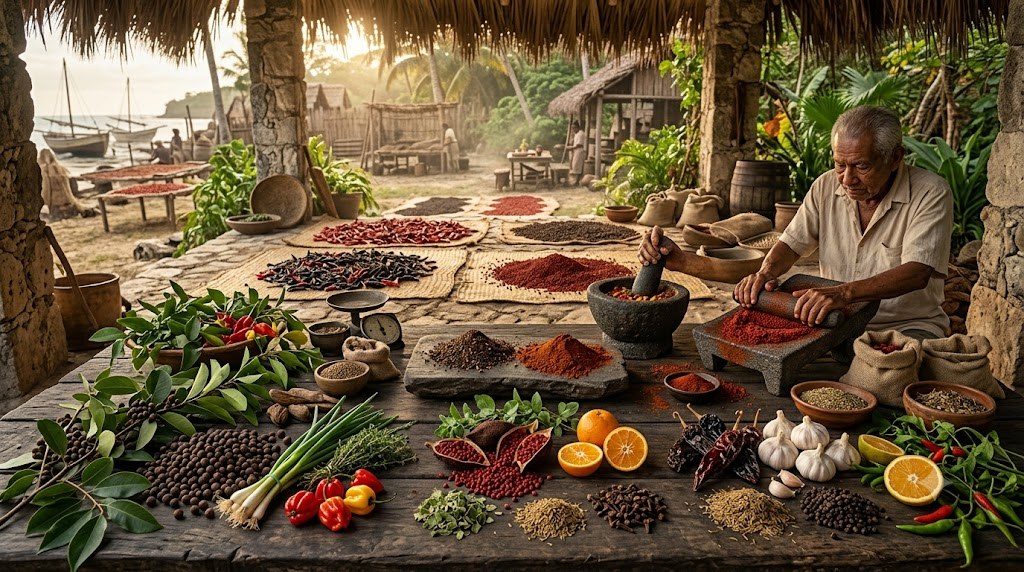
The culinary landscapes of the Caribbean basin and Latin America represent some of the most dynamic intersections of indigenous botanical heritage, transatlantic trade routes, and complex volatile chemistry. Across these tropical terroirs, iconic seasoning blends—ranging from fiery Jamaican jerk rubs and deep ruby Yucatecan recado rojo to versatile Puerto Rican adobo and Brazilian tempero baiano—were forged through the collision of Mesoamerican aromatics, European curing techniques, and West African culinary traditions.
Far from simple dry dustings, Caribbean and Latin American spice preparations frequently exist as thick, lipid-rich wet pastes, acidic marinades, and coarse textural rubs. These formulations exploit precise chemical interactions between lipophilic carotenoid pigments, potent eugenol-rich myrtle berries, capsaicinoid heat gradients, and volatile organosulfur compounds. Examining the chemical composition, pH-dependent enzyme tenderization, and thermodynamic behaviors of these spice matrices reveals the intricate food science underlying their legendary flavor potency.
1. Jamaican Jerk Chemistry: The Pimento-Capsaicin Synergy
Rooted in the survival strategies of Jamaica’s Maroons—escaped enslaved Africans who allied with indigenous Taíno people in the Blue Mountains during the 17th century—jerk seasoning began as a preservative curing rub for wild boars. Smoked underground in pimento wood pits to evade detection by colonial forces, jerk developed an inimitable volatile footprint anchored by two indigenous botanical powerhouses: Jamaican pimento (Pimenta dioica, or allspice) and the fiery Scotch Bonnet pepper (Capsicum chinense).
The chemical profile of authentic jerk seasoning relies on a sophisticated tripartite aromatic framework:
- Allspice / Jamaican Pimento: Yielding 3-5% essential oil consisting overwhelmingly of eugenol (65-80%), accompanied by cineole, phellandrene, and caryophyllene. This volatile cocktail provides a deep clove-like medicinal warmth backed by hints of cinnamon and nutmeg.
- Scotch Bonnet Pepper: Delivering between 100,000 and 350,000 Scoville Heat Units (SHU) via dihydrocapsaicin and capsaicin, paired with signature fruity, floral esters (specifically ethyl 2-methylbutyrate and hexyl acetate) that distinguish C. chinense from common jalapeños.
- Thyme (Thymus vulgaris): Contributing phenolic thymol and carvacrol, which exert powerful antimicrobial action while adding sharp, herbaceous counter-notes to dense animal fats.
- Alliums (Scallions & Garlic): Imparting sulfur-containing allicin and diallyl disulfide compounds that interact synergistically with phenolic spices during high-temperature grilling.
When combined into a fresh wet paste with raw pimento berries, fresh scallions, grated nutmeg, ginger, and soy or brown sugar, jerk transforms into an aggressive curing matrix. The salt and natural acids initiate partial protein denaturation on meat surfaces, while lipophilic eugenol and capsaicin penetrate muscle tissues, stabilizing fats against lipid peroxidation during lengthy, low-temperature pit smoking over green allspice hardwood.
2. Recado Rojo and Achiote: Carotenoid Dynamics and Earthy Terpenes
Originating in the Yucatán Peninsula of southeastern Mexico, Recado Rojo (Red Seasoning Paste) is an ancient Mayan seasoning blend fundamentally driven by the seeds of the achiote tree (Bixa orellana). While best recognized globally for imparting a vibrant red-orange hue to slow-roasted Cochinita Pibil, achiote is an extraordinary culinary botanical from both a chemical and functional perspective.
The outer coating of achiote seeds is rich in apocarotenoid pigments, primarily bixin (a lipid-soluble cis-carotenoid) and norbixin (a water-soluble dicarboxylic acid derivative). Beyond acting as a legendary natural food colorant, bixin is an exceptionally potent singlet oxygen quencher and lipid antioxidant, preventing fats from developing rancid, warmed-over flavors during prolonged barbecue smoking or braising.
To produce authentic recado rojo, ground achiote seeds are combined with Mexican oregano (Lippia graveolens, high in carvacrol and distinctly more herbal-citrusy than European oregano), toasted cumin (cuminaldehyde), allspice berries, cloves, black pepper, and bitter orange juice. This acidic paste forms a complex chemical environment where low pH accelerates collagen breakdown in tough pork cuts while carotenoids tint the exterior flesh with brilliant crimson brilliance.
3. Puerto Rican Adobo and Sazón: Everyday Foundation Blends
In Hispanic Caribbean cooking—particularly Puerto Rico, Cuba, and the Dominican Republic—dry and wet seasoning blends serve as ubiquitous pantry staples. Adobo Seco functions as the foundational salt-spice rub for everyday meats, poultry, and seafood. A balanced scientific formulation typically includes coarse sea salt, granulated garlic, ground black pepper, Mexican oregano, and ground turmeric or cumin.
Parallel to adobo is Sazón, a commercialized yet culturally essential seasoning blend instantly identifiable by its vibrant red-orange coloration and potent umami footprint. The standard chemical matrix of Sazón consists of:
- Achiote / Annatto Seed Extract: Delivering intense visual saturation via bixin carotenoids without altering moisture levels.
- Cumin & Coriander: Providing warm, earthy terpinoid mid-tones (cuminaldehyde and linalool).
- Garlic and Onion Powders: Supplying dehydrated organosulfur volatiles.
- Monosodium Glutamate (MSG): Providing concentrated sodium salt of glutamic acid, triggering T1R1/T1R3 umami receptor signaling and dramatically amplifying the perceived savory depth of rice, beans, and stewed braises.
| Blend Attribute | Jamaican Jerk Paste | Yucatecan Recado Rojo | Puerto Rican Adobo Seco | Bahian Tempero Baiano |
|---|---|---|---|---|
| Physical State | Coarse, wet, fibrous paste | Dense, clay-like malleable paste | Free-flowing dry granular powder | Fine to medium dry ground powder |
| Primary Heat Driver | Scotch Bonnet pepper (Capsaicin) | None / very mild (black pepper) | Black pepper (Piperine) | Malagueta pepper / Cayenne (Capsaicin) |
| Dominant Aromatics | Eugenol (allspice), Thymol, Allicin | Sesquiterpenes (achiote), Carvacrol, Cumin | Allicin, Piperine, Carvacrol | Cuminaldehyde, Coriander linalool, Turmeric |
| Acid / Liquid Vehicle | Citrus juice, vinegar, or rum | Bitter Seville orange juice (naranja agria) | None (dry salt carrier) | None (dry powder carrier) |
| Visual Signature | Deep herb-green to charred dark mahogany | Brilliant saturated brick red / crimson | Pale garlic-yellow / tan | Vibrant golden mustard yellow |
| Signature Applications | Jerk chicken, pork shoulder, grilled fish | Cochinita Pibil, Poc Chuc, tamales | Pollo guisado, roast pork pernil, steaks | Moqueca fish stew, vatapá, black bean feijoada |
4. Afro-Brazilian Dimensions: Tempero Baiano and Dendê Oil Integration
In the northeastern Brazilian state of Bahia, the African diaspora created Tempero Baiano, an aromatic spice blend that mirrors West African spice sensibilities adapted to South American botanicals. Composed of ground coriander, cumin, turmeric, sweet paprika, white pepper, and dried oregano, this golden blend is frequently fortified with dried Malagueta chili peppers (Capsicum frutescens).
In Bahian culinary science, Tempero Baiano is almost never used in isolation; it is chemically intertwined with Azeite de Dendê (red palm oil extracted from Elaeis guineensis). Dendê oil supplies an abundance of beta-carotene, tocotrienols, and saturated palmitic fatty acids. When Tempero Baiano is bloomed directly in hot dendê oil, lipophilic spices such as cumin and turmeric dissolve instantaneously into the fatty acid carrier, generating the signature golden-red emulsion and earthy-nutty aroma that defines traditional seafood Moquecas.
5. Acidic Marinades, Osmotic Pressure, and Preservation Dynamics
A crucial technical hallmark separating Caribbean and Latin American wet spice pastes from dry Old World spice powders is their reliance on acidic aqueous carriers. Wet jerk pastes and recado rojo pastes leverage natural organic acids (citric acid from limes and bitter oranges; acetic acid from cane vinegar) to establish a marinade pH typically between 3.5 and 4.5.
This acidic environment exerts profound functional consequences on culinary proteins:
- Surface Denaturation: The low pH causes swelling and partial denaturation of muscle myofibrillar proteins, loosening tight cellular fiber bundles.
- Accelerated Moisture Binding: When combined with 1.5–2.0% salt concentrations, meat surfaces experience enhanced water retention during the initial stages of high-heat roasting.
- Pathogen Inhibition: The combination of low pH, high osmotic pressure from salt, and phenolic antimicrobials (thymol, eugenol, carvacrol) drastically impedes psychrotrophic foodborne pathogens, enabling safe ambient curing under tropical climates.
Frequently Asked Questions (FAQ)
Q: What gives Jamaican jerk seasoning its signature earthy-warm aroma?
The overwhelming signature aroma of authentic jerk seasoning comes from Jamaican pimento (allspice berries), which contain up to 80% eugenol. This imparts a deep, clove-cinnamon-nutmeg bouquet that perfectly complements pungent fresh scallions and thyme.
Q: Is achiote in recado rojo spicy hot?
No. Achiote seeds from Bixa orellana possess zero capsaicin and are not spicy hot. Their primary sensory contributions are an earthy, slightly nutty, and subtly bitter flavor, accompanied by brilliant red coloration from bixin carotenoids.
Q: Can habanero peppers be substituted for Scotch Bonnet peppers in jerk seasoning?
Yes. Habanero peppers belong to the same species (Capsicum chinense) and exhibit similar heat levels (100,000 to 350,000 SHU). While Scotch Bonnets have slightly fruitier, sweeter top notes, habaneros provide an excellent chemical and sensory substitution.
Q: Why is bitter orange (naranja agria) used in authentic recado rojo?
Bitter Seville oranges supply an optimal blend of malic and citric acidity with aromatic peel oils that cut through rich pork fat. The acidic pH (~3.2) also solubilizes the norbixin compounds in achiote and initiates tenderizing protein denaturation.
Q: What is the difference between dry jerk seasoning and wet jerk marinade paste?
Dry jerk seasoning consists purely of dehydrated ground spices (allspice, thyme, garlic powder, chili flakes, sugar, salt). Wet jerk marinade paste incorporates fresh scallions, crushed fresh pimento berries, raw scotch bonnet peppers, and lime juice, offering far superior enzyme activity, volatile freshness, and caramelizing sugars.
Q: How does Sazón seasoning achieve such an intensely savory taste?
Commercial Sazón blends rely on monosodium glutamate (MSG) alongside garlic and onion powders. The MSG binds directly to umami taste receptors on the tongue, amplifying the natural glutamates and nucleotides present in stewed meats and legumes.
Q: Why is pimento wood traditionally used to smoke Jamaican jerk?
Green pimento wood contains dense reservoirs of eugenol-rich volatile resins. When slowly burned over coals, the wood produces aromatically rich smoke that continuously infuses the exterior of the meat with concentrated phenolic allspice compounds.
Q: Can recado rojo be stored at room temperature once hydrated?
Once reconstituted with citrus juice or vinegar into a wet paste, recado rojo should be refrigerated in an airtight glass container. While its low pH and spices provide mild antimicrobial preservation, ambient storage in warm climates risks mold proliferation.
Q: What role does Mexican oregano play in Latin spice blends?
Unlike Mediterranean oregano (Origanum vulgare), Mexican oregano (Lippia graveolens) belongs to the verbena family. It contains higher levels of carvacrol and citrusy monoterpenes, providing an herbal, earthy pungency that resists dilution in heavy stews.
Q: Why is adobo seco commonly used as an overnight dry brine for roast pork (pernil)?
The coarse salt in adobo draws out surface moisture via osmosis, dissolves the garlic, pepper, and oregano aromatics, and then reabsorbs deeply into the muscle tissue, seasoning the meat throughout while drying the skin for crisp crackling.
Q: What is the botanical source of allspice, and why is Jamaica considered the premier origin?
Allspice comes from the dried berries of Pimenta dioica, an evergreen tree native to the Caribbean. Jamaican pimento is renowned globally because the island’s unique terroir, altitude, and harvesting practices yield berries with significantly higher essential oil concentrations (up to 5% eugenol-rich oil).
Q: How does frying Tempero Baiano in dendê oil alter its chemical delivery?
Dendê oil provides lipophilic fatty acids that act as organic solvents for the carotenoids in paprika, curcumins in turmeric, and terpenes in cumin. Frying blooms these compounds, accelerating molecular diffusion and creating an emulsion that coats the palate.
Q: Can recado rojo paste be made in advance and frozen for long-term storage?
Yes. Due to high concentrations of antioxidant carotenoids (bixin) and antimicrobial essential oils (eugenol, thymol), recado rojo freezes remarkably well for up to 12 months in airtight plastic wrap or vacuum bags without loss of aroma or pigment integrity.
Q: What is the difference between Jamaican green seasoning and dry jerk powder?
Jamaican green seasoning is a fresh, wet herb purée dominated by scallions, culantro (shadow beni), thyme, garlic, and scotch bonnets, designed for short marinades. Dry jerk powder is an ultra-stable blend of dried pimento, dehydrated alliums, ground chili, and brown sugar intended for dry-rubbing and commercial processing.
Q: How does the smoking wood type influence the chemical flavor of jerk meats?
While pimento wood is traditional and infuses pure eugenol smoke, authentic Jamaican pits often use sweetwood (Lauraceae family) as a companion hardwood. Both woods produce high-lignin, low-resin smoke rich in guaiacol, syringol, and phenolics that chemically bind to spiced fats during 4 to 6 hours of indirect smoking.